By Patrick Foley, Business Owner
Common Gutter Installation Mistakes at a Glance
- Wrong pitch is one of the most common installation errors and causes water to pool rather than drain toward the downpipes.
- Brackets spaced too far apart lead to sagging runs that pull away from the fascia under the weight of water and debris.
- Choosing the wrong gutter material for your property type or local exposure shortens the life of the whole system.
- Poorly sealed joints and outlets are the fastest route to internal damp and damage to your walls and foundations.
- Replacement work by Munster Gutters carries a 10-year workmanship guarantee, and a Lifetime Leak Guarantee on any job involving a full gutter replacement.
Why Correct Gutter Installation Matters
Gutters look simple from the pavement, but getting an installation wrong is easier than most people expect. A run that sits at the wrong angle, brackets that are spaced too generously, or joints that are not properly sealed will all cause problems within a year or two. Water that does not drain cleanly away ends up against the fascia, under the eaves, or soaking into the wall. Left long enough, that turns into damp, mould and rot that costs far more to fix than the gutters themselves.
This guide covers the mistakes we see most often across Cork, Limerick, Kerry, Waterford, Clare and Tipperary, and explains what to check for on any installation, whether it is new work or a replacement of an old system.
How a Gutter System Works
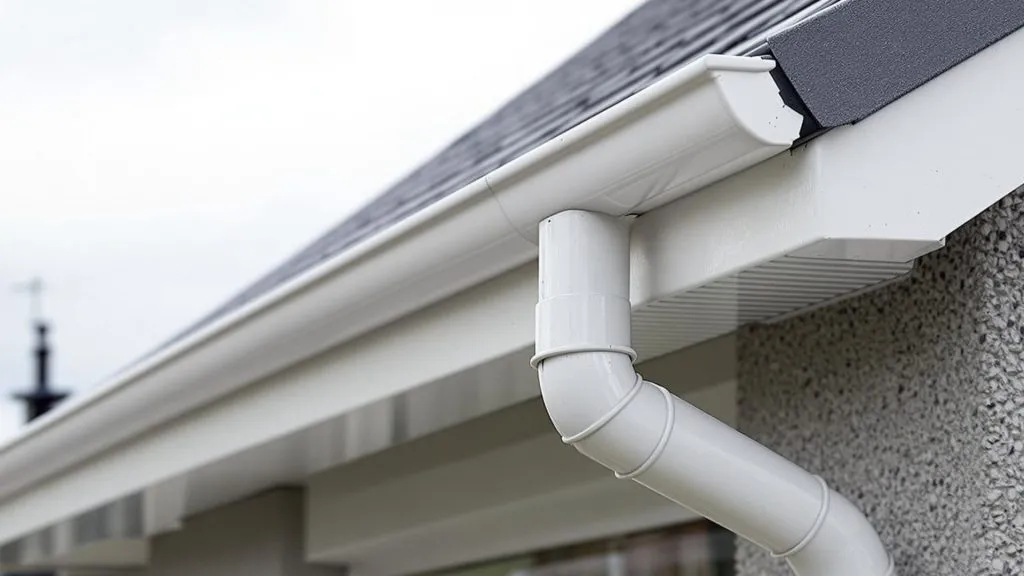
A gutter system has one job: catch rainwater as it runs off the roof and carry it safely to the drains. The gutters sit on brackets fixed to the fascia board below the roof edge. They slope slightly toward the downpipes, which carry the water down the wall and into the drain below. Outlets, stop-ends, angles and unions connect the sections into a sealed run. Every component needs to be the right size, at the right angle and securely fixed. When one element is off, the whole run underperforms.
The Most Common Installation Mistakes
1. Getting the Pitch Wrong
Gutters need a slight downward slope from the high point of the run toward the downpipe outlet. Too little slope and water sits in the gutter, eventually overflowing at the lowest point. Too steep and it rushes past the outlet and over the end. A steady, even fall along the full run is what allows water to drain without backing up.
This is the mistake we see most often on older Irish homes where the original fixings have shifted over the years. The brackets drop unevenly, creating a wavy run with low spots that hold water. If your gutters are overflowing at a point that is not near a downpipe, uneven pitch is usually the reason.
2. Brackets Too Far Apart or Not Secured Properly
Brackets carry the weight of the gutter, the water inside it, and in autumn the debris sitting on top of that. Space them too far apart and the gutter sags between fixings. Sag changes the pitch, creates low spots, and over time pulls the run away from the fascia. In a heavy downpour, a sagging run can flex enough to overflow even if everything else is correct.
The right spacing depends on the material. Heavier materials need closer support. On any property near the Atlantic coast in Cork, Kerry or Clare, the brackets also need to be fixed securely enough to cope with high winds. Marine environments are harder on fixings than sheltered inland sites, and the specification should reflect that.
3. Wrong Material for the Property
The three materials we fit are uPVC, aluminium and cast iron. Each suits a different type of property.
| Material | Best suited to | Key advantage |
|---|---|---|
| uPVC | Most modern homes and standard semi-detached properties | Good value, low maintenance, easy to source |
| Aluminium | Coastal and exposed properties; anywhere with salt air | Corrosion-resistant; marine-grade options available |
| Cast iron | Period properties, protected structures, conservation areas | Authentic appearance; 60 to 80 or more years of life when properly maintained |
Fitting uPVC on a protected Victorian terrace in Limerick or Cork city centre will not satisfy the planning requirements, and it will not match the existing cast iron on the neighbouring houses in the row. Equally, fitting cast iron on a standard 1990s semi is unnecessary expense. Choosing the right material for the building and its setting is part of the specification, not an afterthought.
4. Leaking Joints and Outlets
Every join between two sections of gutter, and every outlet, corner and stop-end, needs to be properly sealed. On uPVC systems that usually means a rubber seal compressed by the union clip. On cast iron it means proper jointing compound or gaskets. A joint that is not fully seated or not sealed correctly will drip from day one. In Ireland's rainfall, that is not a small problem. Water dripping onto the fascia board softens the timber, rots it from behind, and eventually means you are replacing boards as well as gutters.
5. Downpipe Placement and Size
The downpipes carry all the water the gutter collects. If a run is long, one downpipe at the end may not be enough, particularly in the heavy rainfall common across Munster in autumn and winter. An undersized downpipe backs up, and backed-up water in the gutter has nowhere to go except over the front edge or under the back lip.
Downpipes also need to connect to the drain below. Water discharging against the wall base is as damaging as water overflowing from the gutter above. Getting the outlet position and the drainage connection right at the installation stage avoids problems that can be difficult to fix later without disturbing paving or paths.
6. Not Accounting for Munster Rainfall
Standard gutter profiles are sized for typical UK and Irish conditions, but western and southern Munster get intense rainfall events that can overwhelm a system that is technically correct but undersized for the exposure. Properties in Kerry, west Cork and the Clare coast face heavier sustained rainfall than sheltered inland sites in Tipperary or Waterford. Specifying a deeper or wider profile on exposed properties is not over-engineering; it is the right call for the climate.
What a Professional Installation Should Include
A correctly done replacement or new installation covers:
- Removal and disposal of the old system
- Inspection of the fascia board behind, with replacement if it is rotten
- New brackets at the correct spacing and fixed securely to sound timber
- Gutters set to the correct fall toward each outlet
- All joints, angles and stop-ends properly seated and sealed
- Downpipes fixed at the correct positions with secure clips
- A flush-through and check before the crew leaves the site
What It Costs
Price depends on material, the length of the run, the number of downpipes and what access is needed. As a general guide for properties across Munster:
| Material | Typical semi (around 20 m) | Larger or detached (around 50 m) |
|---|---|---|
| uPVC | €1,000, €1,400 | €2,900, €3,600 |
| Aluminium | €1,300, €1,800 | €3,600, €4,500 |
| Cast iron (period or conservation) | €2,100, €2,800 | €5,500, €6,500 |
These figures include removing and disposing of the old system, new brackets, downpipes and outlets. Large or complex properties can run higher. We provide a free written quote before any work begins, so there are no surprises.
See our pricing page for more detail, or our gutter installation service page for what is included.
Keeping Gutters in Good Condition After Installation
Even a well-installed system needs maintenance. Leaf debris builds up through autumn, and moss washed off the roof settles in the gutter runs over winter. A blocked gutter behaves exactly like an incorrectly pitched one: the water has nowhere to go and overflows.
- Clear gutters at least twice a year, typically late autumn after the leaves have fallen and again in spring.
- After any significant storm, check that debris has not blocked the outlets or downpipes.
- Look for signs of sagging, which suggest a bracket has come loose or the fascia behind it has softened.
- Drips from joints, particularly after heavy rain, are worth attending to before they damage the board behind.
Our gutter cleaning service and gutter maintenance page explain what a professional clean covers and when to book one.
Guarantees on Installation Work
Replacement work carried out by Munster Gutters comes with a 10-year workmanship guarantee. Any job that involves a full gutter replacement also carries our Lifetime Leak Guarantee. Manufacturer warranties on materials apply in addition to these.
Repair work carries a minimum of 3 years, and up to 10 years on major repairs.
Further Reading
- Gutter replacement service
- Gutter repair service
- Fascia and soffit replacement
- Gutter installation: a step-by-step guide
- Modern guttering solutions for Munster homes
- Gutter maintenance tips for longevity
If you are planning a gutter replacement or want to know whether your existing installation has any of these problems, we are happy to take a look. Call us on 021 7020328 (Cork), 061 535761 (Limerick, Clare and Tipperary), 066 4004809 (Kerry) or 051 263717 (Waterford), or get in touch through our contact page to arrange a free, no-obligation quote.
Frequently asked questions
What is the most common gutter installation mistake?
Getting the pitch wrong is the mistake we see most often. If the gutter does not slope steadily toward the downpipe outlet, water pools in the low spots and eventually overflows. The fix is to set the brackets so the run falls evenly from the high end to the outlet.
How far apart should gutter brackets be?
The correct spacing depends on the material. Heavier materials such as cast iron need closer support than uPVC. On exposed coastal properties in Cork, Kerry or Clare, the brackets also need to be fixed to cope with high winds. Your installer should specify the right spacing for your material and site.
Can I fit uPVC gutters on an older period property?
Not always. On protected structures or properties in conservation areas, planning requirements often specify that the original material must be retained or matched. In practice, that usually means cast iron or cast-iron-effect aluminium rather than uPVC. It is worth checking with your local authority before specifying the material.
Why are my newly fitted gutters already leaking at the joints?
A leaking joint usually means the seal was not properly seated at installation. On uPVC systems the rubber gasket in the union clip must be compressed fully when the clip is closed. On cast iron the jointing compound needs to be applied correctly and allowed to cure. A leaking joint should be repaired promptly to protect the fascia board behind it.
Do I need a larger gutter profile on a property in Kerry or west Cork?
Possibly. Western and southern Munster can get intense rainfall that overwhelms a standard profile, even one that is correctly fitted. A deeper or wider section handles those peak flows better. It is worth discussing the exposure of your property with the installer before settling on a profile.
How many downpipes does a house need?
It depends on the length of the run and the roof area draining into it. A long gutter run with only one downpipe at the end can back up in heavy rain. As a general rule, longer runs and larger roof areas benefit from an additional downpipe in the middle of the run rather than relying on one outlet to handle everything.
What materials does Munster Gutters install?
We fit uPVC, aluminium and cast iron. uPVC suits most modern homes. Aluminium, including marine-grade options, is the right choice for coastal and exposed properties. Cast iron is used on period properties, protected structures and conservation areas. We also fit cast-iron-effect aluminium where the authentic look is needed without the full cast-iron cost.
What guarantee comes with a gutter replacement?
Replacement work carries a 10-year workmanship guarantee. Any job involving a full gutter replacement also carries the Lifetime Leak Guarantee. Manufacturer warranties on materials apply in addition.
How much does a full gutter replacement cost in Munster?
For a typical semi-detached house with around 20 metres of guttering, uPVC runs roughly €1,000 to €1,400, aluminium €1,300 to €1,800, and cast iron €2,100 to €2,800. Larger or more complex properties cost more. We provide a free written quote before any work begins.
Does incorrect gutter installation affect my home insurance?
It can. If a claim arises from water damage and an assessor finds the gutters were poorly installed or not maintained, the insurer may reduce or decline the claim. Keeping gutters in good working order and having documented records of any work carried out is good practice.
How often should gutters be cleaned to keep them performing correctly?
At least twice a year in most parts of Munster: once in late autumn after the main leaf fall, and again in spring. Properties overhanging trees or in areas with heavy moss growth on the roof may need an additional clean. After a significant storm it is worth checking that debris has not blocked the outlets.
Can a sagging gutter run be repaired, or does it need full replacement?
It depends on why it is sagging. If the bracket has come loose from sound timber, re-fixing it is usually straightforward. If the fascia board behind has rotted, the board needs to be replaced before the bracket can be properly secured. In some cases a section of gutter is also damaged and needs replacing. A survey will establish what is actually needed.