

County Tipperary sits at the heart of Munster, sheltered from Atlantic gales by the mountain ranges that frame it, yet the county's roofs take a quiet, persistent battering that coastal observers often underestimate. The Galtee and Comeragh foothills funnel cold, wet air down across the Golden Vale, driving rainfall into every unsealed joint and cracked mortar bed. Up on the higher ground, winter freeze-thaw cycles work at ridge pointing and valley lead with the same relentless patience as any coastal salt wind. The result is a county full of beautiful, hard-working homes — cut-stone farmhouses outside Cahir, Victorian terraces in Carrick-on-Suir, mid-century semis in Tipperary Town, older council and heritage stock in Templemore — all of which need roofing contractors who genuinely understand the Tipperary climate rather than simply crossing the county boundary.
At Munster Gutters we have been carrying out roof repairs across Munster since 2010. We are council-approved, carry €6.5 million public liability insurance, and back our work with a minimum three-year guarantee, rising to ten years on major structural repairs. Every job starts with a free, no-obligation quote — and because our teams are already working regularly across Tipperary, call-out times are short and local knowledge is genuine.
Roof Repair Types We Cover Across County Tipperary
Roof Leak Repair
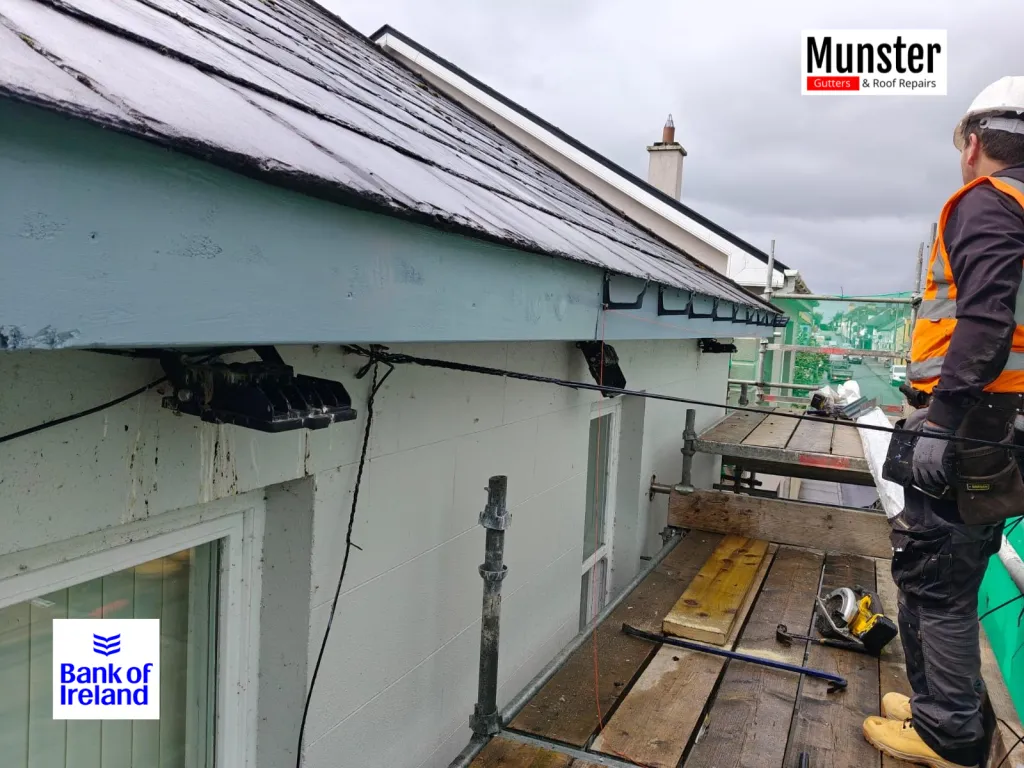
Tipperary's sustained winter rainfall — especially the heavy, wind-driven showers that roll off the Galtees and track north-east across the vale — means roof leaks here often develop gradually rather than appearing overnight after a single storm. Water finds hairline cracks in pointing, travels along rafter lines and only shows itself on a ceiling weeks later. Our leak-tracing process uses a methodical zone-by-zone inspection rather than a quick visual scan, which matters on Tipperary's older cut-stone and slate properties where the original detailing is complex. Once the source is confirmed, we repair it correctly the first time and issue a written guarantee to match.
Slipped or Missing Slates
Natural slate was the dominant roofing material across Tipperary for generations and remains so on the county's substantial stock of pre-1960s housing. Nibs corrode, fixing nails oxidise, and individual slates work loose — especially on north-facing pitches where frost sits longest. A single slipped slate on a Tipperary farmhouse or period town house is not a cosmetic issue; it is an open invitation for the next bout of prolonged rainfall. We source matching natural and fibre-cement slates, re-bed and re-nail correctly, and check the surrounding courses so the repair blends and holds.
Ridge Repointing
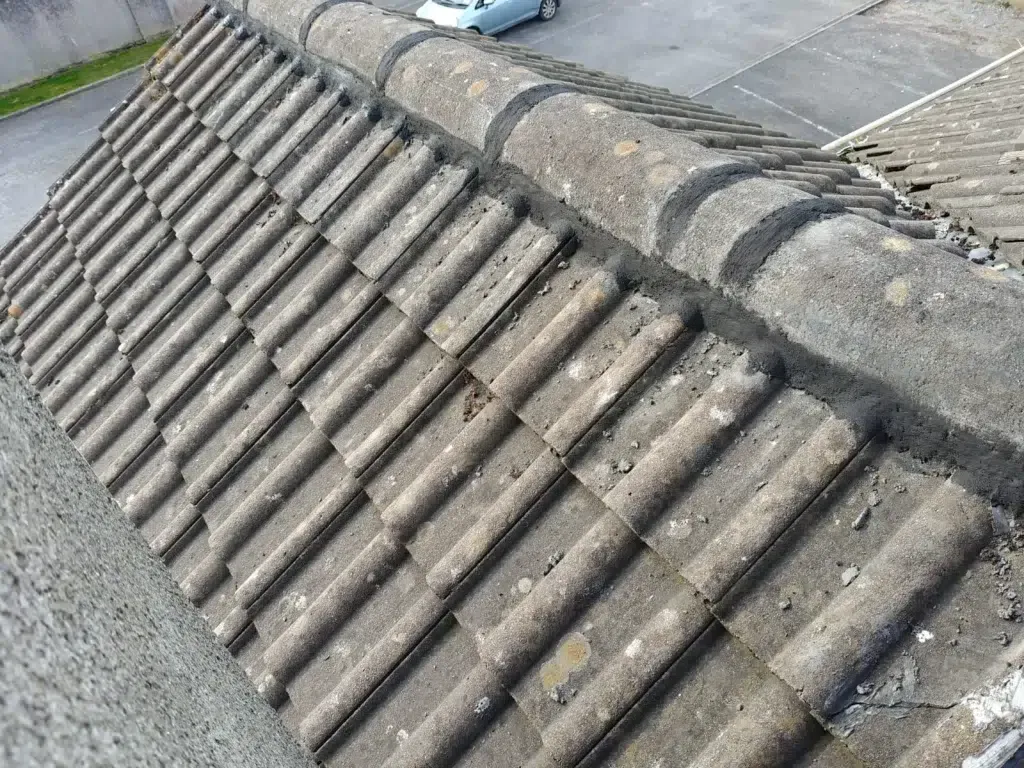
Ridge mortar on Tipperary roofs is under particular stress. The county's upland exposures mean genuine overnight frosts through November to March, and the freeze-thaw cycle is the single biggest enemy of traditional lime-and-sand ridge pointing. Cracks appear, mortar pops, and ridge tiles begin to rock. Left unattended, a rocking ridge tile becomes a dislodged one, and the exposed timber below deteriorates rapidly. We hack out failed mortar fully rather than bridging over it, prime the ridge tiles, and re-bed in a specification suited to Tipperary's thermal range. Where ridge tiles themselves are cracked or spalled, we replace them to match.
Chimney Flashing Repair
Tipperary's heritage towns contain a high proportion of homes with working or redundant chimneys in original cut stone or brick, and flashing failure is consistently one of the top three causes of roof leaks we are called to across the county. Lead step flashings corrode at the mortar joints; soakers lose contact as the pointing around them shrinks; back gutters fill with debris washed down the Galtee-facing pitches. Our chimney flashing repairs use code-compliant lead, correctly dressed and wedged, with all mortar joints raked and repointed in a weather-resistant mix. Where an old chimney has been capped and is no longer used, we can advise on full weatherproofing as a long-term alternative.
Flat Roof Repair
Extensions and outbuildings across Tipperary's towns and rural holdings frequently carry flat or low-pitched roofs, many of which were laid in felt systems that are now well past their design life. Standing water — a particular issue where box gutters or internal outlets are undersized for Tipperary rainfall events — accelerates felt failure and causes blistering and splitting. We carry out targeted patch repairs on flat roofs that still have structural life, and where the deck itself is sound we can overlay in modern GRP (fibreglass) or torch-on systems that offer dramatically improved longevity. All flat roof work comes with a written guarantee.
Cracked or Broken Tiles
Concrete interlocking tiles became widespread on Tipperary's housing estates from the 1970s onward, and age, thermal movement, and the occasional branch strike or access ladder placed carelessly against a fascia can crack them. A cracked tile allows water beneath the lap, soaking the felt layer below, which then wicks moisture to the timbers. We stock a wide range of tile profiles and can source discontinued patterns through our suppliers, keeping repairs near-invisible. On larger areas of tile damage — sometimes the result of localised hailstorms that track inland from the south — we can re-tile whole sections economically as part of a single mobilisation.
Roof Felt Replacement
Beneath the slates or tiles of most Tipperary roofs lies an underlay or felt layer that acts as the secondary line of defence. On pre-1980s properties this is often a bitumen-based felt that has become brittle and perforated over decades of temperature cycling. When this layer fails, even a small slate displacement can lead to significant internal water damage. Full felt replacement involves stripping the roof covering, renewing the underlay to modern breathable membrane standards, and re-laying the slates or tiles with new fixings. It is a significant investment, but on Tipperary's older housing stock it is frequently the repair that stops a recurring problem permanently.
Valley Repair
Cut valleys in lead, and swept or laced valleys in slate, are common on Tipperary's older detached and semi-detached housing. Valley lead creeps and cracks with thermal movement; mortar bedding in tiled valleys fails under frost pressure. A leaking valley is often misdiagnosed as a chimney or ridge problem because the water travels laterally before appearing internally. We identify valley failures accurately, replace lead to the correct code and weight, and reinstate tile or slate courses at the correct angle and lap. On properties near the Comeragh or Galtee foothills where moss growth is heavy, we also clear valley channels during the repair to prevent future blockage and damming.
Storm Damage Repair
While Tipperary is shielded from the worst Atlantic gusts, the funnelling effect of the Galtee and Knockmealdown mountain passes can produce surprisingly damaging localised wind events, and named storms tracking inland regularly dislodge ridge tiles, lift flashings, and strip slates in exposed townland positions. We respond quickly to storm damage calls across the county, provide photographic evidence documentation suitable for insurance claims, carry out emergency make-safe work where required, and follow up with permanent repairs once conditions allow. Our €6.5 million insurance cover means every repair is backed by a contractor your insurer can rely on.
Moss and Algae Removal
The moisture-laden air that settles across the Golden Vale and pools in the sheltered valleys around Cahir and along the Suir corridor creates ideal conditions for moss and algae colonisation on roof surfaces. Moss retains moisture against slates and tiles, accelerates frost damage, and blocks valleys and gutters. We carry out professional low-pressure soft washing — never high-pressure blasting, which damages surface texture and shortens roof life — followed by application of a biocide treatment that inhibits re-growth for several years. Moss removal is also a sensible precursor to any more substantial repair work, as it allows a clearer inspection of the underlying roof condition.
Why Tipperary Homeowners Choose Munster Gutters
- Genuinely local presence: Our teams work regularly in Clonmel, Thurles, Cashel, and Nenagh, as well as throughout rural Tipperary — local knowledge of building types, materials, and weather patterns is built in, not improvised.
- Council-approved contractor: Carrying the council-approved designation matters when you are dealing with insurance claims, grant applications, or protected structure requirements in Tipperary's heritage towns.
- €6.5 million public liability insurance: Every repair carried out by Munster Gutters is covered, protecting you and your property completely.
- Guarantees that mean something: A minimum three-year written guarantee on all repair work, rising to ten years on major works such as full re-roofing, ridge replacement, and valley lead renewals.
- Free, honest quotations: We visit, inspect thoroughly, and provide a written quote with no call-out charge and no pressure. If a repair is not yet necessary, we will tell you.
- Serving Munster since 2010: Over fifteen years of verifiable work history across the province, with Tipperary homeowners among our longest-standing repeat customers.
Roof Repairs Tipperary — FAQs
My farmhouse outside Cahir has natural slate and the ridge mortar keeps failing every few years — is there a longer-term fix?
This is a very common pattern on older Tipperary stone properties, and repeated short-term re-pointing is usually a false economy. The root cause is typically a combination of original lime mortar that has been overpointed with a cement-rich mix — which traps moisture rather than allowing it to breathe — and thermal movement driven by the temperature range on an exposed rural pitch. The correct solution is to hack back fully to sound substrate, assess whether the ridge tiles themselves have deteriorated beyond re-use, and re-bed in a flexible, breathable mortar specification suited to natural slate roofs. Done properly, a ridge repoint on a Cahir-area farmhouse should give ten or more years of trouble-free service.
We had a surveyor flag potential felt failure on our 1970s semi in Tipperary Town — how urgent is this?
It depends on the extent of the failure and the condition of the slates above. Brittle or perforated underlay on a property of that era is a known issue — the original mineral felt has typically reached the end of its serviceable life after fifty years of Tipperary winters. If the slates above are in reasonable condition and well-fixed, felt failure alone may not produce an immediate leak, but you lose all secondary protection if any slate displaces. We would recommend a free inspection: we can assess whether targeted repairs to the felt are viable in accessible areas, or whether a planned programme of renewal is the more cost-effective approach over a two-to-three-year horizon.
There is significant moss growth on the north side of our roof in Templemore — will removing it damage the slates?
Professionally carried out moss removal will not damage sound slates. The key is low-pressure soft washing rather than high-pressure water jetting — high pressure erodes the surface of both natural and fibre-cement slates, shortens their life, and can dislodge fragile fixings. We use controlled low-pressure equipment combined with an appropriate biocide, which kills the moss at the root and treats algae spores that would otherwise re-establish within a season. In Templemore and elsewhere on the northern inland slopes of Tipperary, we typically recommend combining moss removal with a thorough roof inspection, as the moss coverage can conceal slipped slates or deteriorating pointing that would otherwise go unnoticed until a leak develops.
Does Munster Gutters cover repairs on older buildings near the Rock of Cashel heritage area — are there any restrictions I should know about?
Yes, we work regularly in and around Cashel, including on properties within protected structure designations and the broader architectural conservation area. Works on a protected structure or within a designated conservation area in Tipperary may require prior written consent from Tipperary County Council, and the choice of materials — particularly lime mortar, natural slate, and lead — will generally be specified to match the original construction. Being council-approved means we are familiar with this process and can advise you on what consent, if any, your specific repair is likely to require before we begin work. Routine maintenance repairs — repointing a chimney stack, replacing like-for-like slates — typically fall below the consent threshold, but it is always worth confirming with the planning authority for protected structures.